
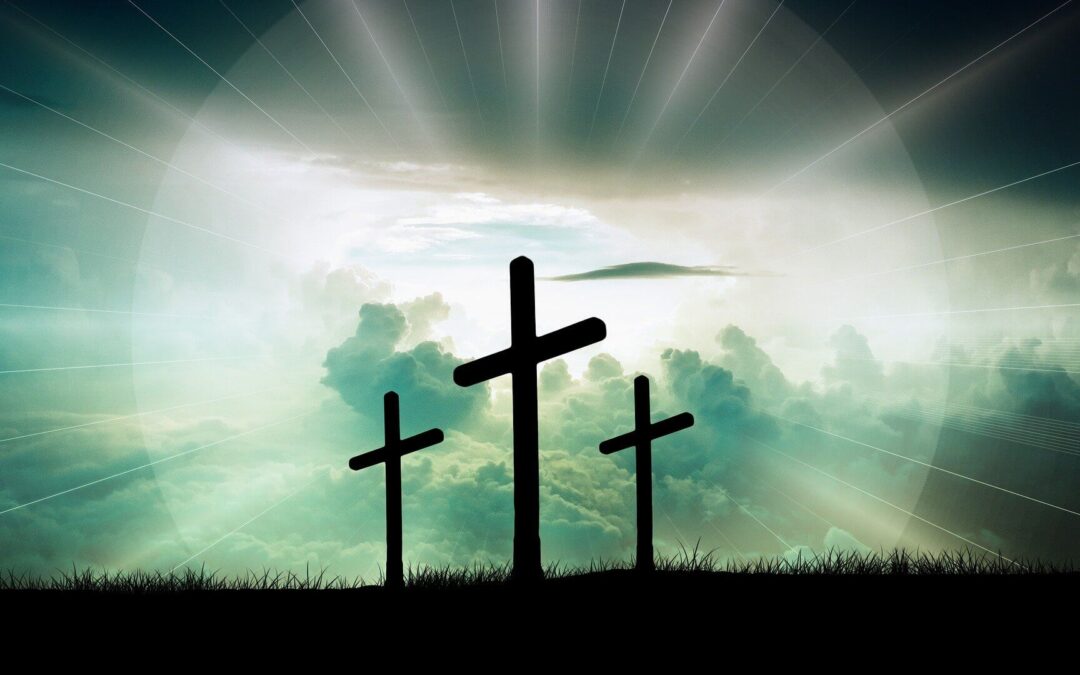
“… Let Him save Himself … save Thyself … save Thyself and us…” Luke 23:35, 37, 39 KJV
“…Let Him save Himself…save Yourself…save Yourself and us…” Luke 23:35,37,39 NASB
God created an innocent, flawless man and placed him in a garden where every need was met, and every desire satisfied. He was made in God’s image, a rational, relational being with the privilege of self-will and the responsibility which they brought.
We are all familiar with the tragic event which ensued as he abused that great privilege. The immediate result was that man became a self-centred being rather than a God-centered being. The first response to the entrance of sin was instinctive self-preservation. “Adam hid” to escape the voice and presence of God.
We are told (but hardly need to be told) by experts in human behaviour, that self-preservation is our first and most innate instinct. There are times when a husband will give his life to protect his wife, when a mother will die for a child. Battlefields are littered with the stories of soldiers who not only gave their lives for their country but, at times, threw their bodies on grenades to save fellow soldiers. All such acts of self-sacrifice are worthy of our esteem.
Rising above all of those rare acts so contrary to our native instinct, is the example of our Lord Jesus Christ. From the lips of the rulers and people, the Roman soldiers who milled about the cross, and the thief on the cross came the same cry: “Save Thyself.” Would this Man be marked by self-preservation?
Luke, the Greek physician, has been very careful to portray throughout His Gospel, the moral beauty of the Lord Jesus Christ. The Greeks prized the “ideal man,” the man of virtue. Luke is telling them, chapter after chapter, that here is the ultimate in perfection, in moral beauty.
It is not surprising then, that it is Luke who records these three taunts which were, in effect, a temptation. Just as the Tempter had earlier dared, “Cast Thyself down” as a means of proving His Sonship (Luke 4:9) and displaying Himself, so now the words have been placed by Satan into the lips of men. The Lord Jesus had said, “This is your hour and the power of the darkness” (Luke 22:53). The same temptation which the Lord had faced at the outset of His public ministry is presented to Him at the close.
Think of all He would have established. The rulers said that He could prove He was the “Chosen of God.” The soldiers that He was “King of the Jews.” The thief reminded Him that He could prove He was “the Christ.” Every misunderstanding would be resolved, and every claim established by just “coming down.”
But if the basic flaw in human nature is a life revolving around “self,” rulers, soldiers and the thief were witnessing a man in Whom there was no flaw. Here was the life that did not live for self. Hours earlier, He had sweat in agony in the Garden, breathing out words that must have thrilled a Father’s heart, “Remove this cup from Me; nevertheless, not My will but Thine be done” (Luke 22:42).
This was not the sudden heroic act of a man on a battlefield, an impulsive act of self-sacrifice by a man who places himself in harm’s way to protect a wife. From eternity past (if such an expression makes sense), He knew the cross lay before Him. In coming into the world, His one great purpose was “to do Thy will, O God.” He lived for others. As Man, as difficult as it is for us to fathom this, His life was God-centered. There was no self-preservation instinct, no self-centred thought that ever entered His mind.
Luke has presented to us the Perfect Man, free of the basic flaw of human nature. All we can do is worship at such beauty.
Consider:
Note how in Luke, two of the sayings from the cross also express this similar idea.