
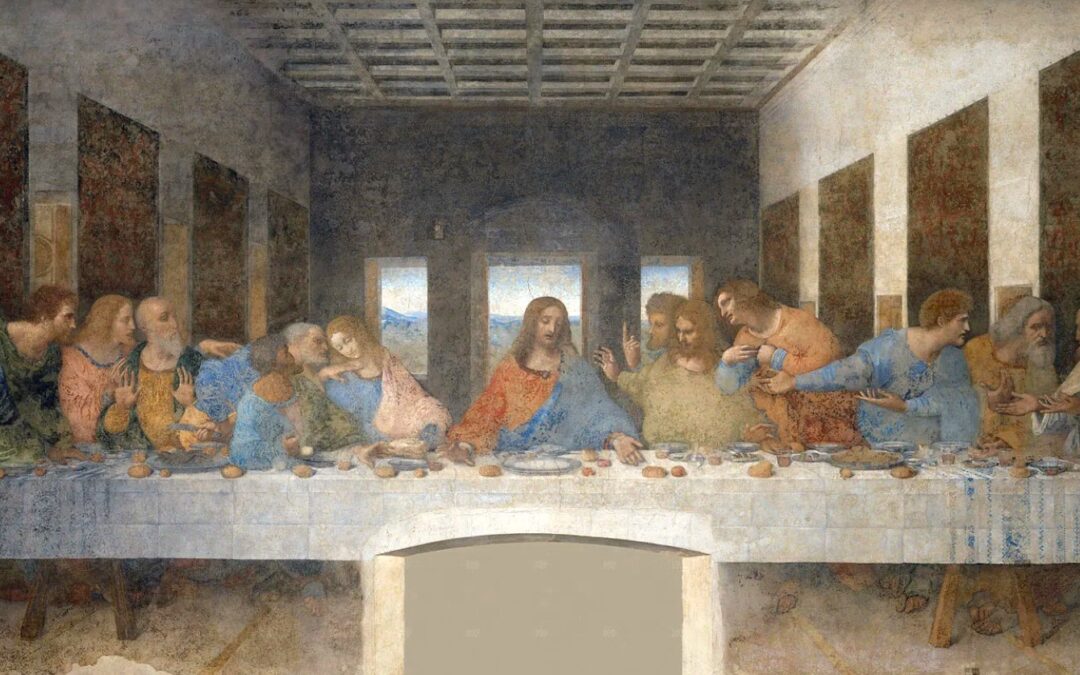
One of the most famous depictions of the Lord’s Supper is the painting commonly called The Last Supper. The event it portrays is recorded in the four Gospels (Matthew 26:17–29, Mark 14:12–25, Luke 22:7–38, John 13:1–38). Later, the Apostle Paul emphasized its significance in the New Testament:
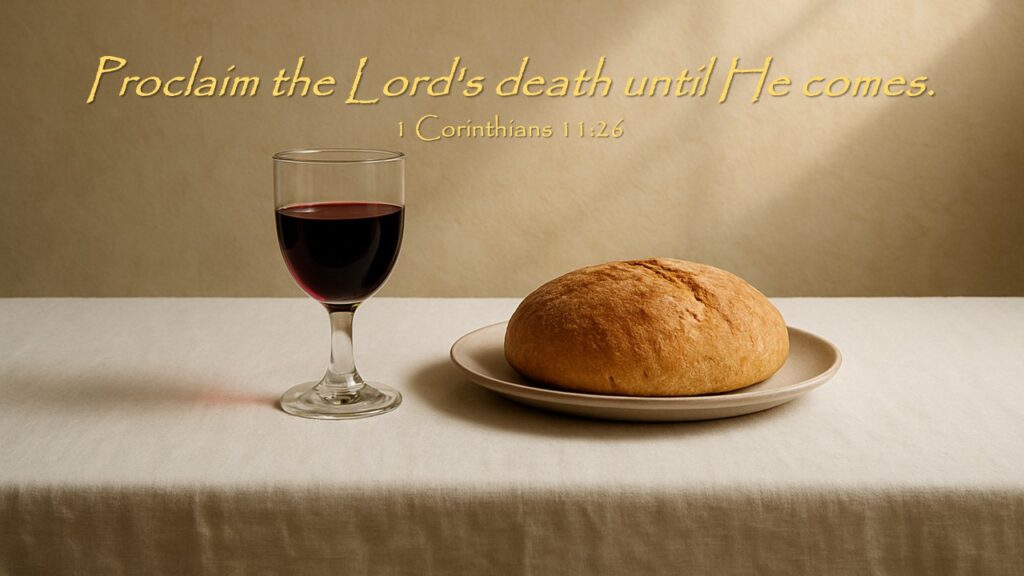
For I received from the Lord what I also passed on to you: On the night when He was betrayed, the Lord Jesus took bread, (24) and when He had given thanks, broke it, and said, “This is My body, which is for you. Do this in remembrance of Me.” (25) In the same way also He took the cup, after supper, and said, “This cup is the new covenant in My blood. Do this, as often as you drink it, in remembrance of Me.” (26) For as often as you eat this bread and drink the cup, you proclaim the Lord’s death until He comes. 1 Corinthians 11:23-26 CSB
Often this occasion is referred to as the Breaking of Bread or the Lord’s Supper. Some faith traditions refer to Holy Communion, the Eucharist, or the Sacraments. There are significant theological differences that emerge when one goes beyond or adds to the references cited above in Scripture. Scripture gives us the clear purpose: it is a simple, weekly gathering to remember and honour the Lord Jesus Christ and His death on the cross.
What the Lord’s Supper Means
Remembrance:
The primary purpose of the Lord’s Supper is to remember both the Person and the work of Christ—His sinless life, His love, and what He accomplished through His death. The bread and the cup are symbols: the bread represents His Body, given for us, and the cup represents His Blood, shed for our salvation. As believers partake of these emblems, they reflect on Christ’s sacrifice and the eternal blessings it provides.
Worship:
The Lord’s Supper is a time of heartfelt worship. Through prayers, hymns, and reflection, Christians focus entirely on Jesus’ death and the joy it brings to God the Father. Every part of the meeting—words, songs, and silent meditation—expresses adoration and gratitude for the Savior.
Fellowship:
This simple gathering also expresses the unity of believers. Sharing in the bread and cup demonstrates fellowship with Christ and with one another, just as the early Christians did. It is a visible sign of the communion of His Body and Blood (1 Corinthians 10:16).
Proclaiming the Lord’s Death:
As Paul reminds us, “For as often as you eat this bread and drink the cup, you proclaim the Lord’s death until He comes.” Four English words help to capture the meaning of the original Greek word used – proclaim, announce, declare, and preach the Lord’s death until He comes.
No gospel like this feast,
Spread for Thy church by Thee,
No prophets nor evangelists
Preach the glad news more free.
As Christians gather once a week to commemorate the Lord’s Supper, they are publicly declaring all the truths concerning the death of Christ, which is the very essence of the Gospel message.
As believers, silently and aloud, reflect on His limitless love, infinite suffering, and the eternal blessings of Calvary, Christians are publicly declaring the Gospel—the death of Christ for sinners. For those watching or reflecting, the Supper can be a powerful witness, touching hearts and leading many to trust Christ as Saviour.
A Growing Collection of Short Testimonies
Saved as a Result of Observing the Lord’s Supper.
Hubert Squires
(Written by Gaius Goff)
We had been preaching in Gander Bay (Newfoundland–Labrador) for a year and a half when Hubert Squires came out for the first time. He told us he had seen such a change in some of his best customers that he wanted to find out what had happened to them. You see, Mr. Squires owned the liquor store, and men from the area regularly came to him to buy beer and other kinds of liquor.
We were holding Gospel meetings in a portable hall in Main Point during the late winter and early spring of 1976, preaching seven nights a week. Mr. Squires began attending and kept coming. One Saturday evening, he asked if he could speak with us. Because of his tracheotomy, it was difficult for him to communicate, but he pressed on. He was convinced he was not a Christian and wanted help to find Christ so he could be forgiven. We read several Bible verses with him, but still, he couldn’t seem to grasp the way of salvation.
As our conversation drew to a close, Mr. Squires rasped through his damaged throat, “You have a meeting here in the morning, don’t you?” He was referring to the Lord’s Supper, when Christians gather for the Breaking of Bread in remembrance of the Lord’s death. Then he asked, “Would it be all right if I came in the morning?” We assured him he would be more than welcome to attend and observe.
The next morning, Hubert Squires was standing on the front steps of the portable hall—the first one there. I asked if he was saved yet, and he shook his head. “No.”
That morning, fifteen Christian men stood at different times to thank God for His Son, each of them speaking of the precious blood of Christ. At the close of the meeting, the Spirit of God led me to speak briefly about “The Blood of Christ.” By then, Mr. Squires was crying, struggling because of his tracheotomy, and he stayed seated long after everyone else had left. I stopped and sat beside him.
“Are you all right? Is there any way I can help you?”
“No. I’m just fine,” he replied. “I heard all about the Gospel, and Christ, and the cross during the evening meetings. But this morning, I saw the Gospel. Those men and women were worshipping Someone they really knew. I came to know Him myself here this morning. The blood of Jesus was shed for me on the cross.”
Mr. Hubert Squires lived for about a year and a half after trusting Christ, and God used him to reach his family and many others. That summer, he served as the chief cook for the crew spreading the Gospel on the Eastport Peninsula. He lived his short time as a Christian to the fullest.

Honor Newell
I grew up in a small community in Southwestern Ontario, where my parents fellowshipped with the Clinton Assembly. I was twelve when, through the preaching of Arnold Gratton, I was first awakened to my need of salvation.
Over the next nine years, I was anxious to be saved, and my greatest desire was to have my sins forgiven. Yet I stumbled over many things. I focused more on the search than on the Saviour. In the words of Scripture, “I was nothing bettered, but rather grew worse” (Mark 5:26).
Looking back, I believe the Lord was showing me what I thought I already knew. I had to:
- Face the fact that I was one of the “wicked” in Psalm 7:11; and
- Realize that all my seeking would never bring salvation unless I personally trusted Christ.
I was 21 when I finally understood that all my sincere, earnest efforts had brought me no closer to Christ or salvation. That summer, when the Gospel Tent meetings began, I had no heart to resume my fruitless search. I listened for a week, and then on Friday night, on my knees beside my bed, I told the Lord that if I were ever to be saved, He would have to save me. I knew I didn’t deserve His mercy, but I asked for it and left the matter entirely with Him. And I truly did. There was a faint hope in my soul, simply because I knew God was merciful, but I had no hope at all in myself.
That Sunday morning, I attended the Lord’s Supper as usual and watched the Christians remember the death of Christ. I heard everything that was said, yet only one sentence remained with me—piercing my soul like a shaft of heavenly light: “God poured out upon His Son all the wrath for all sin.” In that moment, it became perfectly clear that Christ bore all the wrath for all sin, including mine. I received God’s truth as a free gift from Heaven: He died for me.
That was August 11, 1996—almost thirty years ago. I am profoundly thankful to have enjoyed peace with God ever since.
Maxwell Higgins
(Written at Age 9)
I was saved when I was seven. It was October 15, 2017. But the story didn’t start there! I had been searching for a while. My interest began when my Grandfather Martin, read from Psalm 119:130, “The entrance of Your Word gives light.” But I kept getting distracted by my life. The devil had me in his deception.
It was during the Breaking of Bread meeting on Sunday morning, when my father was praying. He mentioned the blind man who said to Jesus: “Lord, I believe.” (John 9:38) The Lord was speaking to me. I prayed: “Lord, I believe.” I knew I was lost and needed to be saved. I also said, “I believe in your Son.” He died for my transgressions. I hope God will speak to others so they too will go to Heaven instead of Hell. I have been saved for two years. Thank God for saving me.
Eloy Espinoza
Palma Sola, Falcón State, Venezuela – 1976
After moving to Kilometer 26 in Falcón State, Eloy Espinoza owned a new 750 truck and spent two nights and a day drinking before heading toward Pueblo Nuevo. When he didn’t return, his wife Celia assumed he was still drinking. In reality, God was working in his heart.
For over twenty years, Eloy had listened faithfully to the Gospel each night at 8 p.m. through Trans World Radio. The Word he heard so often was quietly preparing him for the day God would save him.
That memorable Sunday in 1976, Eloy entered the Palma Sola Gospel Hall for the first time. The believers were gathered for the Lord’s Supper, and the reverence of the meeting deeply moved him. As the hymns and prayers rose, Eloy felt the love of Christ pressing upon his heart. Overcome, he left his seat, approached the table, and knelt on the floor, opening his heart to the Saviour.
One of the preachers, Mr. John Frith (from Canada), gently encouraged him to wait until the meeting ended. Afterwards, Eloy gladly confessed that he had received the Lord Jesus into his heart. He was a transformed man.
Returning home, he embraced his family with tears of joy. When Celia asked what had happened, he said:
“Celia, I am a new creature. I am saved.”
That night, his whole family—and many neighbours he invited—went with him to the Gospel meetings. From then on, Eloy filled his truck with people who wanted to hear about Christ. The series of meetings continued, and Eloy devoted himself to bringing others to the Saviour.
Eloy Espinoza is now with the Lord, remembered for a clean testimony and a life that honoured the One who saved him.
Albert (Bert) Joyce
1927-2017
I was born in Toronto, Ontario, in 1927, but my new life truly began on April 16, 1939, when I became a Christian. I had the privilege of being raised in a God-fearing home where the Word of God was read, revered, and relied upon.
All through my childhood, I received solemn reminders that life is brief and that the Lord could return at any moment. When I was about seven or eight, I would slip quietly past my dying grandfather’s room, and the same thought always crossed my mind: “If that were me, where would my soul be?”
Another occasion left an even deeper impression. When my eighteen-month-old sister died, I came down the stairs and saw the little white casket. Immediately, the question confronted me: “Where would my soul be if it were my body lying there?” I knew the answer—I would be in Hell. A longing to be sure of Heaven was planted deep within me.
Still another reminder came during a serious illness. I was close to death in the hospital with double pneumonia in the days before antibiotics. I overheard the doctor say, “There is no hope.” While Christians at the Toronto Easter Bible Conference were praying that my life would be spared and my soul saved, I remember rolling over in a cold sweat and pleading, “Oh God, don’t let me die and go to Hell.” I even made a promise: “Raise me from this bed of sickness, and I will get salvation.”
The Lord graciously restored my health, but it was sometime later—during a Sunday Worship Meeting at the Lord’s Supper—that my soul was awakened. I watched the Christians so deeply occupied with thanking God for their redemption, and I wondered, “What moves these saints to worship the Lord with such tears?” They sang “When I Survey the Wondrous Cross,” and the third stanza was sung softly:
See, from His head, His hands, His feet,
Sorrow and love flow mingled down;
Did e'er such love and sorrow meet,
Or thorns compose so rich a crown?
My heart longed for what they possessed. I opened my Bible on my lap, and it fell open to Isaiah 53. I began reading verse 6:
“All we like sheep have gone astray; we have turned every one to his own way: and the Lord hath laid on Him the iniquity of us all.”
I read it again, and this time I understood—Christ had borne the iniquity, the sin, of us all. He had died and shed His blood for me. I saw that I was included in both of those “alls,” and immediately I found peace in Christ.
That revelation changed the entire course of my life and set my heart to serving a new Master.
Joanne (Procopio) Kaulback
I grew up knowing from the Bible that I needed God’s salvation. For as long as I can remember, I was troubled about the Lord’s coming and the fear of being left behind. It seemed as though I made a profession in every series of gospel meetings—not to deceive anyone, but because I struggled so deeply with believing.
I thought I had to become utterly desperate in my desire to be saved—brought to “the end of myself”—and then the Lord would save me. I was so convinced that intense inner turmoil was part of the salvation process that when I heard Albert Joyce was attending the Lord’s Supper when he simply trusted Christ, I actually doubted his salvation. How could anyone be saved without all the agony?
Fast-forward to when I was 18, living in Dartmouth (Nova Scotia) and attending school. My entire circle of friends and all my roommates were Christians. One Friday night in May, we were gathered around a bonfire sharing testimonies. Someone suddenly called out, “Joanne, tell us how you were saved.” A silence fell as they realized what they had said. It cut me deeply. I was pretending to be one of them—trying to blend in—but I wasn’t saved.
I decided then that I would make one final, determined effort to “get salvation.” It was now or never. I threw myself into the same old routine—crying, praying, begging God, reading every tract within reach. All Friday night and all through Saturday, I was miserable. Late Saturday night, exhausted and defeated, I turned off my alarm. There was no point pretending I was a Christian anymore, and no point going to the Lord’s Supper in the morning. I flung my Bible across the room and went to sleep.
Sunday, May 31st, dawned bright and sunny. Since I was awake, I decided to go to the Lord’s Supper (the Breaking of Bread) with the other girls. I had resigned myself to the idea that not everyone can be saved, and I certainly wasn’t thinking about salvation as I sat through the meeting.
Before the emblems—the bread and the wine—were passed, one of the Christians, Richard Ross, stood and read from Isaiah 53. When he reached verse 6—
“All we like sheep have gone astray; we have turned every one to his own way: and the Lord hath laid on Him the iniquity of us all,”
—the last phrase struck me: “the Lord hath laid on Him the iniquity of us all.” In that moment, I realized my sins were already gone because they had already been laid on the Lord Jesus.
Because of the beautiful simplicity of it—and because of my many false professions—I wanted assurance that this truly was salvation. I prayed, asking the Lord to show me so I would never doubt again. Immediately, Phillip Morton, another believer, stood and spoke from Hebrews 4:14: “…let us hold fast the profession of our faith,” and then from Hebrews 10:23: “…let us hold fast the profession of our faith without wavering.”
That was all the confirmation I needed. I have never struggled with doubts since. Christ was—and is—and forever will be—my Saviour.
Mark Albert
1936 – 2025
Mark Albert was raised in a Roman Catholic home, but he never practised the religion as an adult. At the age of 26, he married a Christian who, at that time, was failing to make the Lord a priority in her life.
Interestingly, it was Mark who encouraged her to become active again in the local fellowship of believers and attend the Bible meetings. He would often say, “If you believe in something, then go and practise what you believe.” So she did.
Years passed. One year, after returning from a Bible conference, Mark asked his wife how it had gone. She told him that some wondered if it might be the last conference they would ever attend. “There may be none next year.” When he asked why, she replied that the Lord could return before another conference. That simple remark became a turning point in Mark’s life. From then on, he began attending all the Bible meetings and Gospel dinners.
It was a Sunday morning, September 6, 1981. Mark was now 45, and he was observing the Christians fondly remembering the death of the Lord Jesus Christ at the Lord’s Supper. As one man prayed and thanked the Lord for saving his soul, Mark was brought to the foot of the cross. He realized that Christ had died for him, and he was saved.
Mark lived for many more years and passed peacefully into the presence of his Lord and Saviour at the age of 88—absent from the body, and present with the Lord.
Connie Griffin
I grew up in a godly Christian home, hearing the Bible read daily and attending all the meetings of our small fellowship of believers. From a very young age, I was concerned about being saved. I knew I was a sinner and desperately wanted salvation, but I could never seem to “get it.” I always stumbled over the believing—I believed the Bible, but I didn’t feel saved.
When I was in grade 11, during a series of gospel meetings, I became anxious to know for sure. Hebrews 11:6 and 1 John 5:10 seemed to settle it: I believed, and I didn’t want to make God a liar. I was baptized and received into the assembly. I married a good Christian man and tried hard to live faithfully, but doubts remained. I could see my husband growing spiritually while I felt stagnant. This went on for five years..
That summer, we attended the Taylorside (SK) Conference. Saturday night’s gospel meeting left me convinced I was not saved. I spoke with the speakers and my husband, but I was even more confused.
Sunday morning, I went to the meeting as usual. During Mr. Maxwell’s prayer, he quoted two verses:
“Ye were not redeemed with corruptible things, as silver and gold; but with the precious blood of Christ.” 1Peter 1:18-19
“The blood of Jesus Christ His Son cleanseth us from all sin.” 1 John 1:7
Suddenly, it all became clear: it is the blood of Christ that saves, not our effort or our believing. I had been treating my faith as a work, but salvation is entirely His gift.
Back home, still unsure, a dear sister reminded me of the promise:
“When I see the blood, I will pass over you.” Exodus 12:13
That assurance settled my heart forever. From that moment, I knew I was saved.
Darlene (Bain) Frederick
On Sunday, March 14, 1965, at Arnstein Gospel Hall in Ontario, during the Worship Meeting, I was teaching my sister her Sunday School verse.
For God sent not His Son into the world to condemn the world; but that the world through Him might be saved. John 3:17
I accepted that the Lord Jesus was sent to save me, not condemn me. I was thirteen years old when Jesus saved a sinner like me. Very thankful for eternal life.
Lorne McBain
1900-1977
Lorne McBain was born in 1900—the same year his own father was saved. His mother was a Catholic and made sure that Lorne and his brother never attended Sunday School or gospel meetings. Yet through his saved father and grandparents, he often heard the Gospel. When his mother died, Lorne was 19, and her death awakened him to his need of salvation.
While working as an auditor in Toronto (ON), Lorne was invited to the 1920 Easter Conference held at Massey Hall. Sitting in the balcony during the Breaking of Bread, he watched the large company of believers as they remembered the Lord. A solemn, unforgettable thought pressed itself on his heart: “These people are going to heaven, and I am going to hell.”
That afternoon, his uncle introduced him to Mr. John Moneypenny, who spoke kindly with him, asked his age, and told him that he himself had been saved at nineteen. Mr. Moneypenny quoted to him the words of John 5:24 —
Truly, truly, I say to you, whoever hears my word and believes him who sent me has eternal life. He does not come into judgment, but has passed from death to life. John 5:24
As Lorne listened to the verse, he suddenly grasped the truth that Christ had died for his many sins so that he could be forgiven. He said nothing at the time, but left Massey Hall, returned to his rooming house, and—alone beside his bed—fell to his knees. He told God he was a guilty sinner deserving of Hell, but now knew that Christ had died for him and that he was trusting the Lord Jesus to take him to Heaven.
He invited his roommate to return with him to the conference for the evening gospel meeting. As he listened to the preaching of Christ and His finished work, he received full assurance of salvation and immediately began to confess Christ to his relatives and fellow workers.
Years later, Lorne McBain—by then a much-loved servant of the Lord—wrote these words about that unforgettable morning in 1920:
“I remember the time when I sat in the balcony of Massey Hall, Toronto, on an Easter Sunday morning during the conference in 1920. I had been exercised about being saved for some time, but as I witnessed the Christians remembering the Lord, they proclaimed the Lord’s death to me as no gospel preacher could have done. I saw that I was lost and condemned, and felt that God was in the midst of His people (1 Cor. 14:25).”
Carolina Hernández de Antequera
Punto Fijo, Falcón State, Venezuela
A little over thirteen years ago, I met the man who is now my husband, and he was the first to speak to me about the Lord Jesus Christ. Although he encouraged me to attend the meetings, I didn’t go at first because they were held at night and the meeting place was far from my home.
One day, he mentioned that on Sunday mornings, there was also a meeting where believers gathered to worship the Lord and remember Him. So, I began attending on Sunday mornings.
The first time I witnessed the Lord’s Supper, I was deeply impressed by the order, solemnity, and reverence with which it was carried out. I was moved by the love of Jesus shown in His sacrifice, and amazed at how the believers expressed their affection and gratitude toward Him.
From that day on, I began telling God that I also wanted to be part of that congregation—those people who poured out their hearts before Him. I decided to attend the weekday Bible studies as well, and although I found them interesting, none compared to the Lord’s Supper on Sunday mornings.
I used to sit at the back, almost by the door, and sometimes I remained standing, yet my heart was filled with admiration as I watched the dignity of the women and the devotion of the men as they remembered the Lord Jesus. It seemed they were speaking about a beloved, intimate Person—Someone they deeply loved and longed to see again very soon.
One unforgettable Sunday, after the Lord’s Supper, I spoke with one of the believers, asking if I could share in those privileges of blessing that they enjoyed. I felt such joy in making that request. But that brother, with great kindness and care, explained that I first needed to know the Lord Jesus as my Saviour and Lord in order to have fellowship with Him and with His people. He was very considerate in telling me no—but it was exactly what I needed to hear.
That Sunday, March 23, 2014, I returned home and wept. I felt unworthy, and in one of the rooms of my house, I lifted a prayer to the Lord with all my heart, acknowledging my need of salvation.
That same afternoon, I attended the Gospel meeting at the same place—the Gospel Hall on Progreso Street in Punto Fijo. During the preaching, I thought the message wasn’t for me, since deep down I felt that I was already saved. But then one of the brothers quoted Romans 10:9:
“That if thou shalt confess with thy mouth the Lord Jesus, and shalt believe in thine heart that God hath raised him from the dead, thou shalt be saved.” Romans 10:9
Suddenly, I understood that I still needed to confess Him. When the meeting ended, I stood up, spoke with the brothers, and joyfully confessed that the Lord Jesus had saved me.
Since then, my life has belonged to the Lord who loved me and saved me by His grace.
Two years later, the Lord granted me the privilege of marrying Carlos—the instrument He used to bring me to the knowledge of His truth.
Erika (Thiessen) Sawatzky
When I was six years old, I became deeply concerned about my soul. For months, I carried a heavy burden, always trying to believe, yet never finding peace. One Sunday, during the Breaking of Bread in central Mexico—inside a simple Gospel Hall made of tin sheets—I listened to the worship while looking at a two-roads chart on the wall.
As my eyes traced the broad road and the narrow road to their eternal destinations, I reached a point of desperation. I told the Lord that I could do nothing more to be saved—He would have to do it. I admitted that I was a sinner on the way to Hell, but that the Lord Jesus Christ could save me because He had died on the cross for my sins. I asked Him to save me so I could go to Heaven.
That day, He did.
Since then, I have held tightly to the promise of John 6:37: “Him that cometh to Me I will in no wise cast out.”
JFK’s Grand-daughter Tatiana Schlossberg – Spiritual Reflections for You
/
oh how thankful I AM for this THANKSGIVING testimony of what the LORD HATH DONE. Always love to reflect and give thanks for the LORD and HIS work through us, fruit that usually only HE can see because we walk by faith. thank you Peter Ramsey