
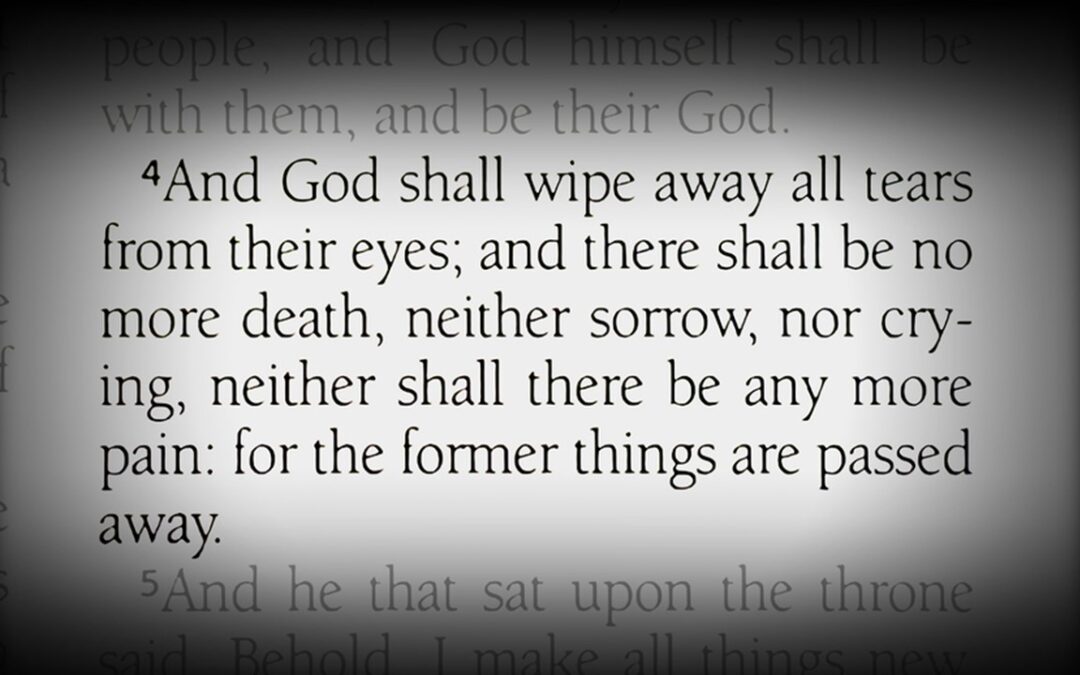
KJV Revelation 21:3-4 And I heard a great voice out of heaven saying, Behold, the tabernacle of God is with men, and He will dwell with them, and they shall be His people, and God Himself shall be with them, and be their God. (4)And God shall wipe away all tears from their eyes; and there shall be no more death, neither sorrow, nor crying, neither shall there be any more pain: for the former things are passed away.”
NASB Revelation 21:3-4 And I heard a loud voice from the throne, saying, “Behold, the tabernacle of God is among men, and He will dwell among them, and they shall be His people, and God Himself will be among them, (4) and He will wipe away every tear from their eyes; and there will no longer be any death; there will no longer be any mourning, or crying, or pain; the first things have passed away.”
Despite much ink being utilized to argue the meaning of many passages of the Revelation, there is relatively uniform agreement that Revelation 21 is a look at the eternal state—the Holy City, the New Jerusalem, the home of the Bride, and the “spirits of just men made perfect.”
The title of this city, the New Jerusalem, begs us to compare it with the old Jerusalem. Though John in Revelation never names the city as such, there is little hesitation to recognize the city described as Sodom and Egypt (Revelation11:8) as the Jerusalem that was.
It was outside the city of Jerusalem that the Lord experienced suffering so that we might enter into the New Jerusalem, where all the very same things will be absent.
We are promised that God will be with us. On that hill outside the city, He knew, for the first time in all the ages of eternity, an interruption in the enjoyment of fellowship with God. He was forsaken that we might never be forsaken.
God will wipe away all tears from our eyes in that new city. Linked with the Jerusalem below was a Saviour who wept tears in Gethsemane (Hebrews 5:7). Never again will a tear flow from His eyes down His cheeks. But they were real tears shed in the Garden, tears that presaged a deeper grief and sorrow at the cross.
“No more death.” Death has been conquered! He took death as a weapon and rendered powerless the enemy who had used death as a scourge to keep men in fear (Hebrews 2:14,15). He died so that we might not endure the second death. He died that we might have a life that will never end, that will never see death.
As you read the promise, “no more sorrow,” you are transferred to the Garden and Luke’s account of His agony. But that was only in anticipation. “And He took with Him Peter and the two sons of Zebedee, and began to be sorrowful and very heavy” (Matthew 26:37). Thus, the Garden was only the beginning of His sorrows. Though His physical suffering was very real, it may be that His greatest sorrow lay in the fact that in rejecting Him, men were rejecting the Revelation of the Father He had provided. So great was His love for His Father that anything that dishonoured Him was of untold grief to the Son.
The “crying” of which our verse speaks is not that of weeping. It is a crying out, a shouting due to pain and suffering. He knew that on the cross. And what of the painless eternity we are promised?
"None of the ransomed ever knew how deep were the waters crossed."
There are no units to measure the depth of His pain and sorrow. He endured it in its entirety and immensity that we might never know it.
Finally, in verse 6, the promise of eternal satisfaction: “I will give unto him that is athirst …” He thirsted on the tree, outside the city, that when we enter in, we might never thirst again.
In the interests of complete transparency, this meditation was suggested by the ministry of another brother. I have “built upon another man’s foundation.”
Consider
How would you link “no more sea (v 1) with this meditation?